

Lilias Trotter – The Obedience of True Faith
Lilias Trotter was a young woman to whom our God gave two important gifts. First was a heart to love and serve Him above all things. The second was an incredible artistic talent that was recognized at that time as one of the greatest in the world. Her immersion into painting deepened as her skills grew. So did her commitment to her spiritual calling. John Ruskin, perhaps the leading artistic influence of that era and Lilias’s art mentor, expressed concern that her ministry work was affecting the character of her art.
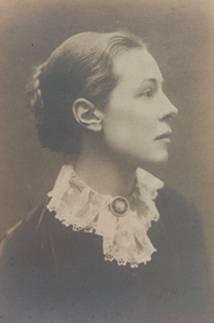
It was with this in mind that Ruskin brought Lilias to his home in the Lake District, in May 1879. His purpose was to put before her the brilliant future he maintained could be hers as an artist. Ruskin believed “she would be the greatest living painter and do things that would be immortal.” A powerful and influential voice in the arts, Ruskin could launch her career single-handedly. But the offer came with a caveat. To become “immortal” she would have to “give herself up to art.”
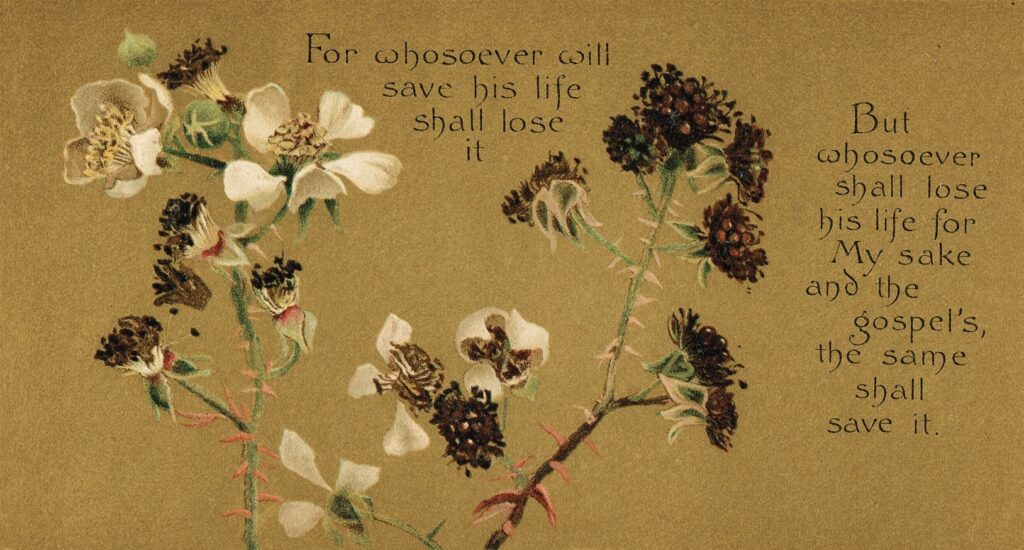
After days of agonizing deliberation, she saw she could not devote herself to both art and to the life and ministry Christ Jesus was living through her. She wrote, “I see clear as daylight now, I cannot give myself to painting in the way he (Ruskin) means and continue to ‘seek first the Kingdom of God and His Righteousness.‘
Many of her friends and family members were shocked by her decision. Still, Lilias returned to London and focused on her ministry work for the next eight years. Then, in May of 1887, she listened to a message about those in North Africa who had never heard the name Christ. She felt the prompting of God to bring the message of Jesus Christ to the people of Algeria.
The following March, at the age of thirty-five, she set off for North Africa. Having left the comforts of upper-class British society to share the gospel to the lost of Algeria, she arrived in March 1888, with two other financially independent women. They were there as self-supporting missionaries not directly supported by any mission board. This unsupported status was due in large part to the fact that none of them were in good enough health to be considered for overseas work.
Her early days in Algeria were hard. They knew no one and knew not a word of Arabic. They took up residency in the Arab section of the ancient city of Algiers. Lilias commented that “three of us stood there, looking at our battlefield, none of us fit to pass a doctor for any society, not knowing a soul in the place, or a sentence of Arabic or a clue for beginning work on untouched ground; we only knew we had to come. Truly if God needed weakness, He had it!”
They faced a challenge in reaching the local people. Yet the team battled on, trying one technique after another to make inroads into the Algerian culture and all the while improving their Arabic. Eventually, Lilias was able to gain access to the heavily secluded Muslim women by first befriending their children. The outreach to women, she believed, was a “great line of cleavage in the rock face of Islam.”
The cost of the work was very high. Those they led to faith in Jesus were sometimes banished, beaten, even (Lilias believed) poisoned with mind-altering drugs. Many converts died. Amazingly, Lilias “…came to rejoice in their loss. We were glad to let them go… One draws a breath of relief when they get safe home to heaven.”
Despite all these battles the work grew. In 1907 five new workers joined the “Algiers Mission Band,” as it was called. By 1920, there were thirty full-time workers and fifteen preaching stations. Lilias had become the reluctant leader of the group.
Over the four decades she stayed in North Africa, Lilias set up mission stations along the coast of North Africa and deeper south into the Sahara Desert. Scouting locations on camel, she visited areas never seen by a European woman. She spent the rest of her years bringing the light, life and love of Jesus to the Arabic people of North Africa. Lilias never returned to live in London.
Perhaps her most important achievement was to be a pioneer in adapting Christian missionary work to the Algerian culture. These adaptations included “a native cafe on a Christian footing,” readings of the Bible in a “rhythmical recitative” accompanied by a drum, a craft house that would teach little girls embroidery, and a Christian retreat for women to take the place of the outings to shrines.
There is only one calling in the Kingdom of our God. That calling is to Christ and to all He would do in and through us. Lilias Trotter embodied that calling from her own pen: “It is a broken spirit that we need–a spirit keeping no rights before God or man, longing to go down, down, anywhere, if other souls may be blessed.”
She died in Algeria in 1928. As she lay dying, she suddenly exclaimed, “A chariot and six horses.” “You are seeing beautiful things?” someone asked. “Yes,” she said, “many, many beautiful things.” Then she raised her arms as though she would hold them all in her embrace, lifted her hands in prayer, and quietly slipped away. The artist in Lilias was finally fulfilled in her going to be with Jesus, the Master Creator.
“Oh, that we may learn to die to all that is of self with this royal joyfulness that swallows up death in victory in God’s world around! He can make every step of the path full of the triumph of gladness that glows in the golden leaves. Glory be to His Name!” – Lilias Trotter
Hat tip to Miriam Rockness and her excellent blog, “Lilias Trotter” for the much of this information about this amazing woman of God. Subtitled as “Miriam Rockness: Reflections on the Art and Writings of Lilias Trotter,” her work can be found at https://ililiastrotter.wordpress.com/. Some of what you read here is taken from her work, as is the artwork by Trotter.
 Without Limit